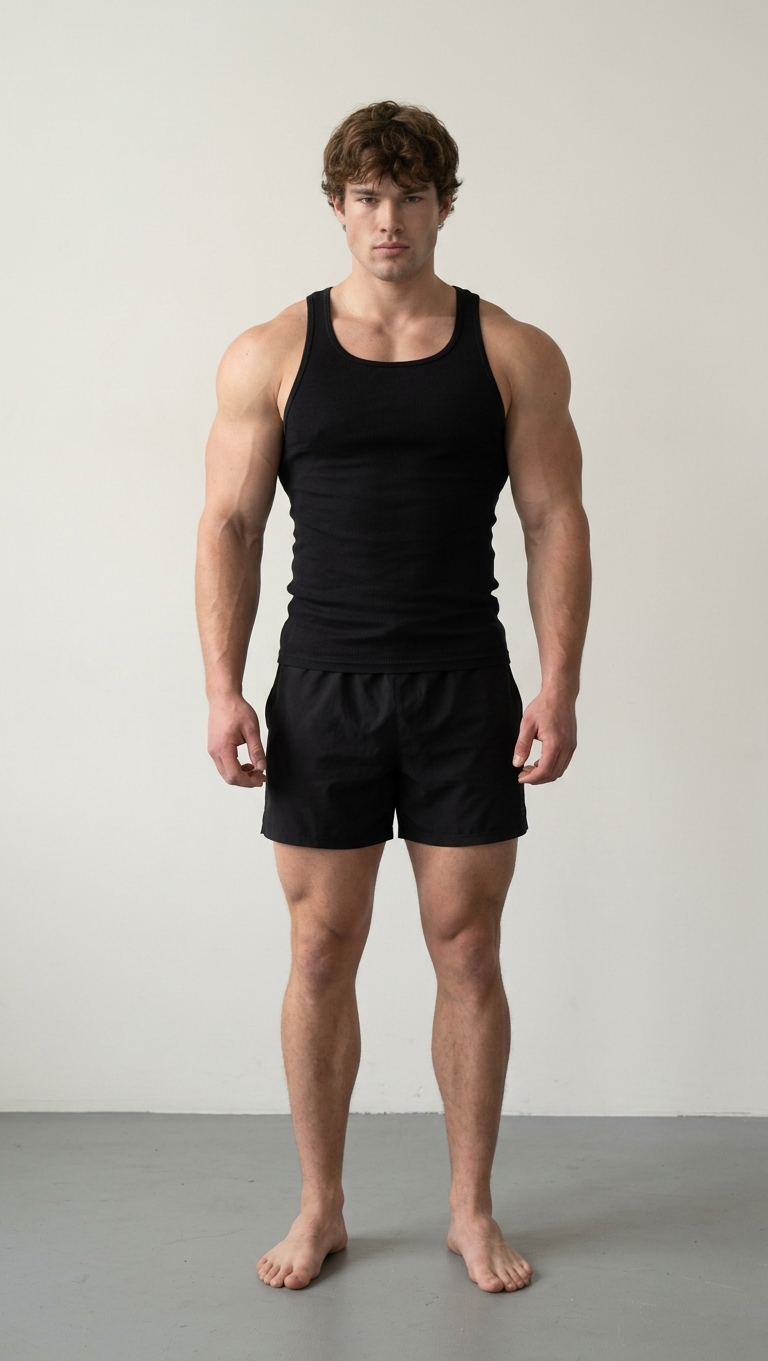
Built from the 6 findings in this scan that are real and that training moves, ordered by how far each one cleared our resolution. You work on what is actually there. Your proportions are not in here: those are bone, and nothing trains them.
General training guidance from your measurements, not a medical assessment. If something hurts, stop, and take these numbers to a physiotherapist.
Whole body leans forward or back
A whole-body lean is usually about where your weight sits over your feet and how the hips and ankles share the job of holding you up. Long periods sitting shorten the hip flexors, which tips the pelvis and shifts the whole stack.
Half-kneeling hip flexor stretch
Kneel on one knee, squeeze the glute of the kneeling side, and shift gently forward until you feel a stretch at the front of the hip.
3 holds of 30 seconds each side, daily
Glute bridges
Lie on your back, knees bent, feet flat. Push through your heels and lift your hips, squeezing the glutes at the top.
3 sets of 12, every other day
Standing weight check
Stand normally, then notice whether your weight sits on your heels, your toes, or the middle of your feet. Aim for the middle.
A few times a day
If a lean came on suddenly, or comes with back pain or numbness, that is a reason to see someone rather than to start a routine.
Head sits forward of the shoulders
This is the measurement most affected by where you spend your hours. Screens below eye level, phones held low, and long stretches without changing position all pull the head forward, and the muscles at the front of the neck shorten to match. It is a habit held by tissue rather than a fixed feature of your skeleton, which is why it responds to work.
Chin tucks
Sit or stand tall. Draw your chin straight back, as though making a double chin, without tipping your head down. Hold, then release.
10 holds of 5 seconds, 2 or 3 times a day
Wall angels
Stand with your back and head against a wall, arms up in a goalpost. Slide your arms up and down while keeping your head, upper back and wrists in contact with the wall.
2 sets of 8, every other day
Thoracic extension over a chair
Sit in a firm chair, hands behind your head, and arch gently backwards over the top of the backrest. Move at the upper back, not the lower back.
8 slow repetitions, daily
Raise your screen
Set the top of your monitor at eye height. This is the change that usually moves this number more than the exercises do.
Once, permanently
Stop if any of this causes pain, dizziness, or pins and needles in your arms or hands. Neck symptoms are worth a professional opinion rather than a routine.
One hip sits higher
A hip height difference can come from standing habits, such as resting weight on one leg, from side-to-side strength differences around the hips, or from a genuine leg length difference, which is present in most people to some degree.
Side planks
On your forearm, hips stacked and lifted, body in a straight line.
3 holds of 20 to 30 seconds each side, every other day
Standing hip hitch
Stand on one leg on a step, let the other hip drop, then lift it using the muscles of the standing hip.
3 sets of 10 each side, every other day
Stop standing on one leg
Notice when you are resting your weight on one hip while standing, and rebalance.
Ongoing
If this comes with back or hip pain, get it looked at. A leg length difference is a thing to be assessed, not exercised away.
Shoulders sit forward of the trunk
Shoulders drifting forward is usually a strength balance rather than a shortness: the front of the shoulder and chest do most of the pulling in daily life and in most gym programmes, and the muscles that hold the shoulder blades back get comparatively little work.
Face pulls
With a band or cable at head height, pull towards your face, elbows high, finishing with your hands beside your ears.
3 sets of 12 to 15, twice a week
Prone T raises
Lie face down, arms out to the sides in a T, thumbs up. Lift a few inches by squeezing the shoulder blades together.
3 sets of 12, twice a week
Balance your pulling and pushing
If you train, count your weekly pulling sets against your pressing sets. Two pulls for every push is a common correction.
Ongoing
This one changes slowly, over months rather than weeks, because it is a strength balance rather than a stretch.
Upper back is rounded
Upper back rounding usually travels with the head-forward pattern and comes from the same source: hours spent leaning towards something. The chest and the muscles at the front of the shoulders shorten, and the muscles between the shoulder blades lengthen and stop working hard.
Doorway pec stretch
Forearm on a door frame, elbow at shoulder height, step gently through until you feel a stretch across the front of the chest.
3 holds of 30 seconds each side, daily
Band pull-aparts
Hold a light resistance band at shoulder height, arms straight, and pull it apart by squeezing your shoulder blades together.
3 sets of 15, every other day
Prone Y raises
Lie face down, arms overhead in a Y, thumbs up. Lift your arms a few inches using the muscles between your shoulder blades.
3 sets of 10, every other day
Keep the effort in the upper back rather than the neck. If your neck does the work, the load is too high.
At the reference. Train it for performance
Your estimate sits at or under the published reference for your sex, so there is nothing here to correct. Conditioning at this point is about what your body can do rather than what it weighs, and a stronger aerobic base is what lets you train harder everywhere else.
Intervals
After a 10 minute warm-up, work hard for 60 seconds, then go easy for 90. Bike or row rather than run if your knees or ankles came up in this report.
6 to 10 rounds, once or twice a week
Loaded carries
Pick up something heavy in each hand and walk. It builds conditioning and grip at once, and it loads the trunk upright rather than bent, which is the opposite of most desk hours.
4 sets of 40 metres, twice a week
Easy steady cardio
Bike, row, incline walk or a slow jog, held at a pace where you could still hold a conversation. If you are gasping, it is too fast, and the point of this session is volume rather than effort.
30 to 45 minutes, 3 times a week
Keep at least one genuinely easy session a week. All-hard training plateaus fast and it is the pattern most likely to end in an overuse injury. This is general training guidance from a tape measurement, not a medical assessment. Body composition from tape carries 3 to 4 percentage points of error, so treat the tier rather than the decimal. If you have a heart or joint condition, are pregnant, or have been told to avoid vigorous exercise, take this to your doctor before starting.
Re-scan in a month under the same conditions. The measurement behind each block above is the one to watch, and the report will tell you exactly how far it moved. Posture changes slowly, so a month that holds steady is a month you did not go backwards.