People rated below average in appearance earned measurably less than people rated above it, in the same jobs. The gap held for men and for women.
82 measurements · 23 referenced · 4 photographs
Your body,measured in detail.
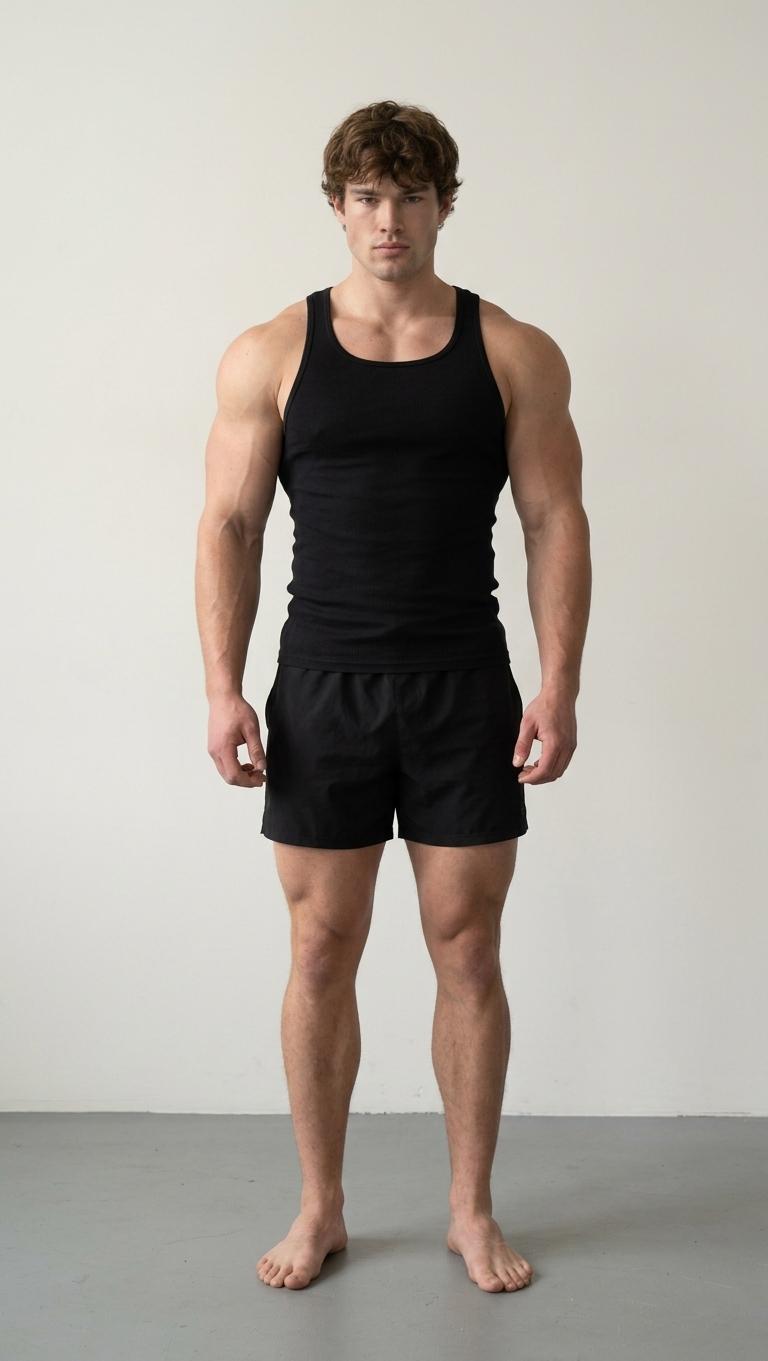
Four standardised photos become 82 measurements of your posture, symmetry and proportions, set against published research and tracked month over month.
Early access. 18+ only.
Why our capture rules are strict
Two degrees isall it takes.
The largest source of error in a photo measurement is the camera, not the body. Tilt one by two degrees and a level pair of shoulders reads as an asymmetry six times larger than the smallest difference we can resolve.
We measured that, so we reject it. Drag the slider and watch a finding appear out of nothing.
level2° · we reject4°
Shoulder height difference
0.0000
we resolve 0.0016
Level, and provably so
Smaller than the smallest difference we can resolve, so the answer is level and the report says so. This is what a correctly captured photograph of a level pair of shoulders returns.
How it works
Four photographs, andthe same four every month.
Hover a step to open it.
- 01
Four photographs
Front, side, feet together, back.
A fixed protocol, shot against a plain wall with the camera level. The same four next month, so this month and next can be compared exactly.
- 02
Measured on your phone
Nothing leaves before it is read.
The landmarks are found in your own browser. Photographs are compressed and measured on your device, then stored in a private bucket only you can open.
- 03
82 measurements
Angles and ratios, to four decimal places.
Across posture, symmetry and proportion, from the same landmarks a motion capture lab works from. 23 are set against published research with the source named on the page.
- 04
A baseline that moves
The second scan is where it pays.
Scan again and the report tells you precisely what changed, by how much, and whether the change is larger than the smallest difference we can resolve.
What the research found
How you are built changeshow you are treated.
Decades of peer-reviewed work, on earnings, on dating, on the judgements strangers make in a tenth of a second. Most people never get to see the measurements behind it. You will.
A tenth of a second of exposure to a face was enough to form judgements about it. More time did not change the judgement, only the confidence in it.
Students were paired at random for a dance. Of everything measured about them, physical attractiveness was the only reliable predictor of whether a partner was liked.
Attractive people were assumed by strangers to hold more socially desirable personalities, and to lead better lives. The assumption came free with the face.
Across four longitudinal studies, physical height predicted earnings and ratings of leadership, after controlling for sex, age and weight.
Your turn
See all 82 measurements we take.
The complete catalogue →
Overall score
Example shape
MarAprMayJunJulAug
Month over month
Scan again.Watch it move.
Every scan is kept and dated, so the report draws your line from your own measurements and tells you exactly what moved, by how much, and when. Small changes compound. This is the part a single scan cannot give you, and it is the reason to come back.
The chart is an example of the shape. The figures under it are ours.
- 0
- Measurements taken, every scan
- 0
- That respond to training
- 0
- Set against published research
The catalogue
All 82,published in full.
Across 9 groups, every one naming what it is built from and which photograph it comes from. 23 are set against published research with the source linked. You can read the entire list before you take a single photograph.
- Trunk and axis7
- Posture, seen from the side13
- Left and right, height10
- Left and right, segment lengths9
- Left and right, joint angles5
- Alignment, seen from the front8
- Seen from behind9
- Proportions17
- Body composition, self-reported4
Questions
Everything people ask,answered properly.
Four photographs, 82 measurements. A free scan measures every one of them and shows you 12: whether you are level, square and upright, read from all four photographs. The full report opens the rest, which is every proportion, the whole side-on posture chain, your score across symmetry, alignment and proportion, and a programme built from your own findings.
Your proportions, all of them, including shoulder to waist, waist to hip and leg to height, each set against published research or the population median. The complete sagittal chain from the side photograph, including forward head position and the four plumb-line deviations. Your score. Every measurement drawn onto your own photograph so you can see the two points it was taken between. And the programme, which attaches specific work to the 61 measurements that respond to training.
We measured it, which is the part that matters. The same body was photographed five times over, twice, on two different people, and we recorded how far every number moved when nothing about the body had changed. That figure is our resolution, it is published, and every measurement in your report is read against it. A reading smaller than the smallest difference we can resolve is reported as level rather than dressed up as a finding, which is why the numbers hold still when your body does.
Exactly what it measured, to four decimal places, against published values where published values exist, and exactly what has changed since your last scan. Forward head position, shoulder protraction, the plumb line down your side, how level your shoulders and hips sit, how your knees and ankles stack. It works from the measurement, not from an opinion about the photograph. It is not a medical assessment and cannot see pain or injury, so anything that hurts belongs with a physiotherapist.
During early access, one person: whoever runs osceo, to check capture quality and write reports by hand while the automated version is validated against them. That is disclosed at signup, in the privacy policy, and again on the upload screen. Every scan opened is written to an access log that survives account deletion, so if you ever ask who has looked at your photographs there is a real answer. The bucket is private, the links expire in ten minutes, and row-level security means nobody else can reach your row.
Yes, from your account page, in one click, and it is a real deletion rather than a flag on a row. The storage objects go first and the process refuses to finish if a single file survives, so an account can never disappear while its photographs are still sitting in a bucket.
It gives you the measurements the research is actually about. A handful of proportions are scored against peer-reviewed work into what people find attractive, and those are labelled as preference findings. The rest are scored on how common they are, where a low score means less common rather than worse. There is no ranking and no percentile against other users, because a number that moves when somebody else signs up is not a measurement of you.
Because most of what is worth measuring is invisible from the front. The entire side-on posture chain needs a profile. Knee and ankle alignment need the feet together against a fixed base. Everything posterior needs the back. The fourth photograph also lets two independent views measure the same thing, which is how the instrument gets checked against itself on every single scan.
We reject them and ask again, which is the part most of this category skips. More than two degrees of camera tilt is an automatic reject, because that alone invents a shoulder asymmetry six times larger than anything we can resolve. Shooting into a window costs the foot and ankle measurements. An arm resting against your side merges it with your torso in the outline, so the waist measurements are refused rather than estimated. A number we cannot stand behind does not go in your report.
A phone, a plain wall, and something to stand the phone on at hip height. That is the whole kit. A tape measure only if you want the body composition add-on, which is the one part of the product built from measurements you take yourself.
From tape measurements you enter, using the US Navy method, and it is sold separately for exactly that reason: it is your data rather than ours, and it carries three to four points of error. It is scored on its own against published health thresholds and never folded into your posture score, because a body fat number inside a posture score turns a posture score into a judgement about your weight. Buying it also unlocks a conditioning programme matched to your reading.
61 of the measurements are posture, alignment and muscular balance, and every one of them responds to work. The programme attaches specific exercises to the findings in your own scan, ordered by how far each one cleared our resolution, so you work on what is actually there rather than on a generic routine. Proportions are the part that does not move, and we say which is which instead of selling you a routine for your femur.
No. The landmarks come from a pose model running in your browser, and every number is arithmetic on those coordinates: angles, ratios and distances, computed the same way every time. Where a language model is involved it is handed the finished numbers and the reference ranges and asked to write them up. It never sees a photograph and it never estimates a measurement.
The scan and your first 12 numbers cost nothing. The full report is a one-off. Body composition is a small add-on and comes free with the tracking subscription, which is the version worth having: one scan is a baseline, and the second one is where this starts being useful. Exact prices land when early access opens.
Join the waitlist.
A free scan measures all 82 and shows you 12, with the context to read them. One email when it opens, and nothing else.
Early access waitlist. 18+ only. A confirmation now, then one email when it opens.